
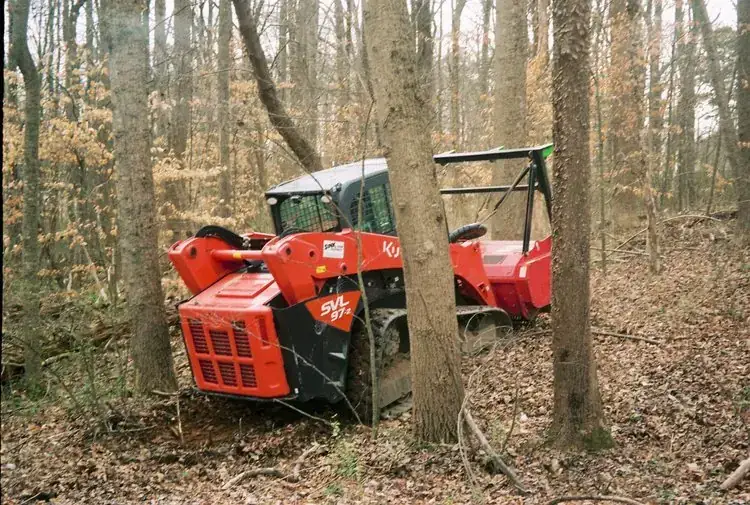
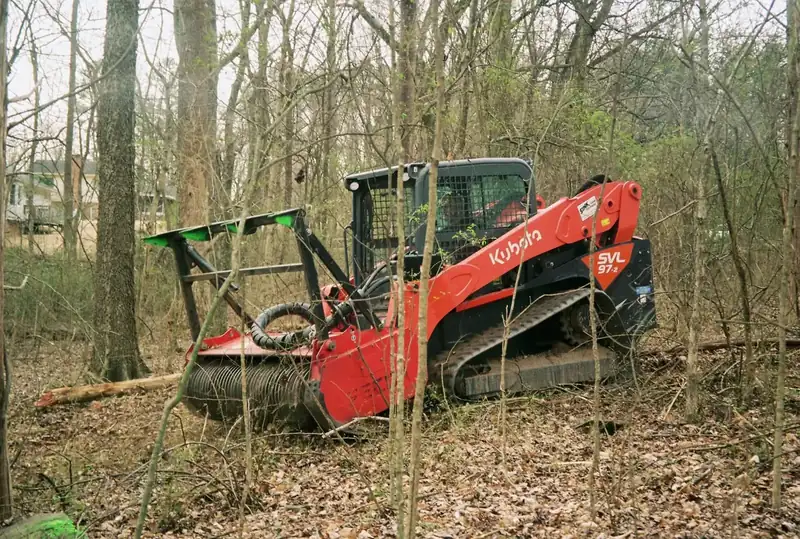
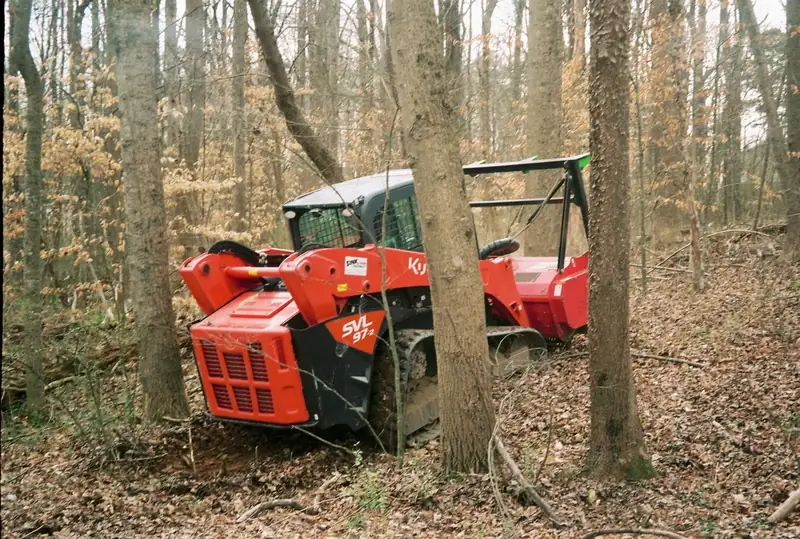
Pasture reclamation in Danville is mostly a mulching job if you catch it before the pines get big. We take the sweetgum, loblolly, cedar and privet to grade in a pass, find the old fence before we hit it, and leave the ground ready to mow and seed.
Piedmont clay around Danville runs acidic, and a field that's been in pine for a decade is worse. Reclaiming it means liming heavy after we mulch — we'll tell you that up front so the seeding plan is realistic.
Danville ground conditions and how they shape pasture reclamation
Virginia's erosion and sediment control law applies at 10,000 square feet of disturbance — much lower than North Carolina's acre — and Pittsylvania County administers it. The Dan River corridor has a Chesapeake-Bay-style riparian protection along the public water intake. On the ground, the Cecil and Appling uplands can be worked almost any month; the Dan, Sandy River and Fall Creek bottoms flood and get the dry-season slots. Rock is lighter than in the Uwharries or the foothills, which makes trenching and pads straightforward most of the time.
Around the Sandy River, US-29 and US-360, the properties we're usually called to look like this:
- Farm roads, pole barn pads and gravel drives on working farms across southern Pittsylvania
- Fifty- to several-hundred-acre deer and turkey tracts toward Ringgold, Blairs and Chatham needing trails, food plots and firebreaks
- Dan River frontage where owners want privet beaten back, a trail to the water and a camp site cleared
What pasture reclamation jobs look like around Danville
A typical Danville call for pasture reclamation looks like this: Farm roads, pole barn pads and gravel drives on working farms across southern Pittsylvania. We've handled that exact situation around US-360 and Chatham, VA more times than we can count.
The other common one is Opening old fields for a homestead, orchard or market garden, which usually means a tighter work area and more care around what stays.
If your property is somewhere in between, send the address and we'll tell you which side of the line it falls on.
We also cover pasture reclamation in Roxboro, Eden and Ruffin, so if you've got property in more than one spot we can often batch the work.
Why Danville property owners call A&R
If the field needs the pond edge cleaned, a drainage ditch opened, or a fence corridor set while we're there, we handle it in the same trip. One contractor for the whole Pittsylvania County reclamation.
Call or text (336) 392-8138 to set up a free pasture reclamation estimate in Danville. We'll walk the field together and tell you what it'll take to get it back to grass.
Pasture Reclamation in Danville: questions
Will the sweetgum and pine come back?
Pine won't resprout from a stump. Sweetgum will, and so will privet. The mulch layer slows them, and two or three mowings the first year usually finishes them off. Leaving the field unmowed for a season after reclamation is the fastest way to lose the work.
What areas do you reclaim pasture in?
Greensboro and everything within about an hour and twenty minutes — the Triad counties, up to the Virginia line, west to Mount Airy and Elkin, south to Salisbury, Albemarle and Sanford, and east toward Durham, Chapel Hill and Raleigh. A lot of our field work is in Rockingham, Randolph, Alamance and Stokes.
How far is A&R Land Services from Danville?
We're based in Greensboro, about 1 hour from Danville. Pittsylvania County is inside the radius we work every week, so there's no long-haul mobilization charge built into your estimate.
Do you handle pasture reclamation near the Sandy River and US-29?
Yes. We work throughout Danville and the surrounding Pittsylvania County area, including properties around the Sandy River, US-29 and US-360. If you're outside the town limits, send the address and we'll confirm it's in range.
What does pasture reclamation typically involve on a Danville property?
Conservation and wildlife openings on recreational land is the most common version of it around Danville. We go through the growth with you — age and size of the pines and sweetgum, where the old fences and terraces are, wet spots, the pond or creek, and what the field is going back to: hay, cattle, horses or just open ground. Chip handling — left in place, windrowed or removed is the factor that moves the price most on Pittsylvania County jobs, and we'll walk through it with you on site.