

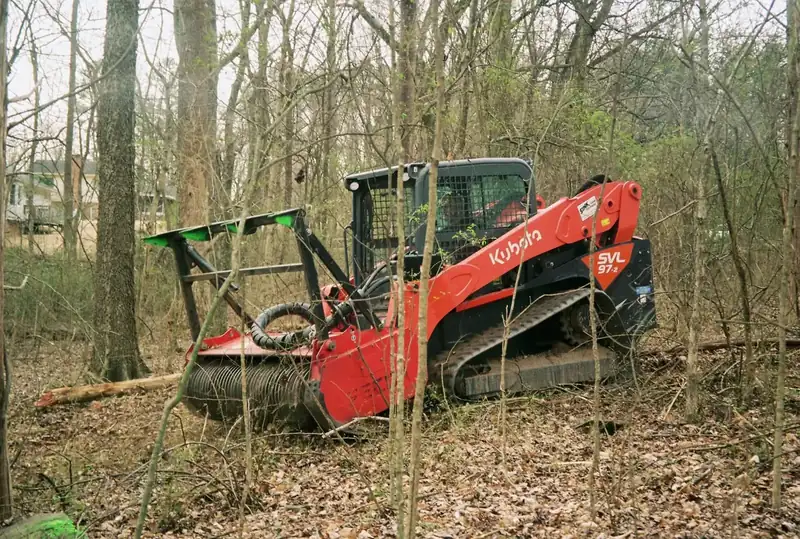
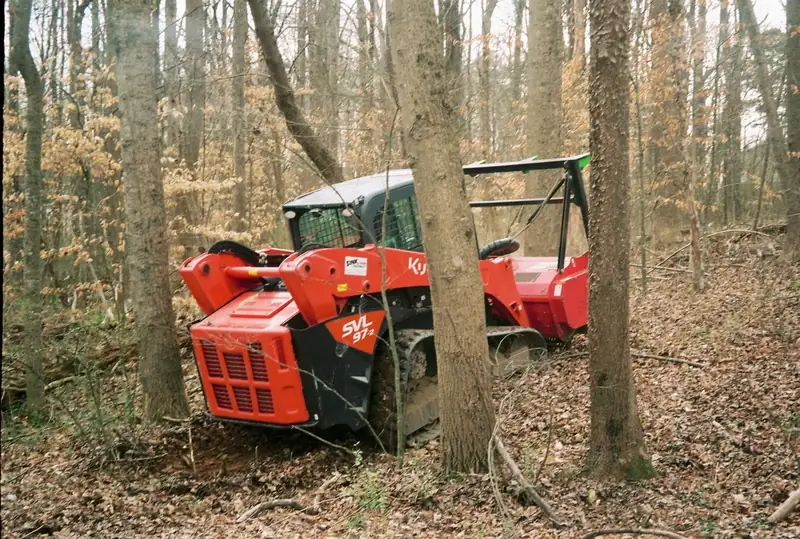
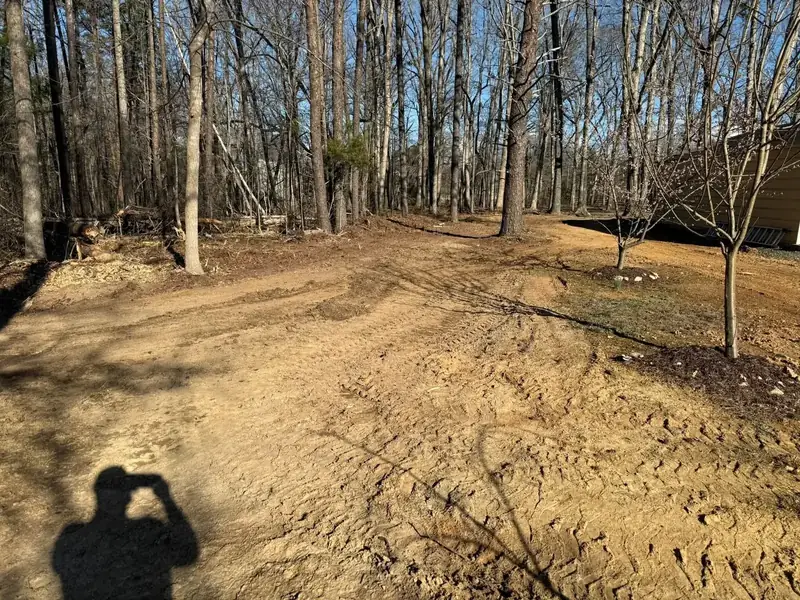
Bush hogging in Lexington with a track loader instead of a tractor means we mow the slopes, the wet corners and the edges under the limbs that the owner's own tractor couldn't reach. The whole Davidson County field gets cut, not just the easy middle.
Fields managed for quail or turkey around Lexington have a nesting window in late spring and early summer when mowing should wait. We'll schedule Davidson County wildlife ground around that if it applies to yours.
Lexington ground conditions and how they shape bush hogging
Lexington is the center of Davidson County and the land around it runs from the Yadkin River on the west to the Uwharrie foothills on the southeast, which means we see three kinds of dirt in one town. North and west toward Tyro and Reeds it is Cecil, Appling and Pacolet red clay; around the city itself and east toward Abbotts Creek it is Enon, Iredell and Mecklenburg shrink-swell clay over diabase; and south toward Southmont and High Rock Lake the Badin and Tatum slate-belt soils start. Abbotts Creek, Swearing Creek and Leonard Creek drain toward the Yadkin, and all three have wide Chewacla bottoms.
Around US-29 / US-70, I-85 and Leonard Creek, the properties we're usually called to look like this:
- Cattle and grain farms toward Tyro, Reeds and Linwood with pasture gone to pine and fence rows lost to honeysuckle
- High Rock Lake lots at Southmont and along NC-8 and Cotton Grove Road needing privet and sweetgum cleared for a view, plus pads and driveways on steep ground
- Abbotts Creek and Swearing Creek bottomland owners want opened for hay, wildlife or a pond
What bush hogging jobs look like around Lexington
One job we see over and over near Leonard Creek: Cattle and grain farms toward Tyro, Reeds and Linwood with pasture gone to pine and fence rows lost to honeysuckle. That's textbook bush hogging work, and it's usually a one-mobilization job for us.
Out toward US-64 the pattern changes — more Hay fields and pasture that missed a cutting. The approach is the same, the time on site is what moves.
Either way, the first question we ask on a Lexington site walk is what the ground needs to do afterward, because that decides how far we take it.
If you're just outside Lexington — Mocksville, Wallburg, Welcome or anywhere between — you're still inside our regular range.
Why Lexington property owners call A&R
If the field needs a fence line cleared, a wet spot drained or a corner mulched while we're there, we do it in the same Davidson County trip. One contractor for the field, not three.
Call or text (336) 392-8138 to get your Lexington field or lot mowed. One-time or scheduled — the estimate is free either way.
Bush Hogging in Lexington: questions
Can you mow a lot that got a code violation notice?
Yes, and that's a common call. Greensboro, High Point, Burlington and most Triad towns enforce overgrowth ordinances on vacant lots. We can usually get a lot mowed within a few days of the call, and we'll leave the edges clean enough that the inspector signs off.
How much does bush hogging cost per acre in NC?
Mowing is the least expensive thing we do with the machine, and it's priced by acreage and growth. Tall grass and weeds on open, flat ground go fast. Briars, saplings and a field full of hidden junk take longer. Scheduled cuts cost less per visit than a one-time rescue because the growth never gets heavy. We give a written number after seeing the field, and the estimate is free.
How far is A&R Land Services from Lexington?
We're based in Greensboro, about 45 minutes from Lexington. Davidson County is inside the radius we work every week, so there's no long-haul mobilization charge built into your estimate.
Do you handle bush hogging near US-29 / US-70 and I-85?
Yes. We work throughout Lexington and the surrounding Davidson County area, including properties around US-29 / US-70, I-85 and Leonard Creek. If you're outside the town limits, send the address and we'll confirm it's in range.
What should I expect from a bush hogging job in Davidson County?
Back acreage on rural homesites that's getting away is the most common version of it around Lexington. Perimeter and fence lines first, then the interior in passes, working tight around buildings and under limbs. Obstacles found during the walk get flagged and mowed around. Access and how far the field is from where we can unload is the factor that moves the price most on Davidson County jobs, and we'll walk through it with you on site.