

If the city sent a letter about your Martinsville lot or the back field got away from you this summer, we'll knock it down. Veteran and fireman owned, based in Greensboro, and bush hogging in Henry County is the fastest-scheduling work we do.
Pasture edges in Henry County — along the creek, under the tree line, around the pond — are where the tractor stops and the brush starts. On Martinsville farms we mow those strips with the track machine so the pasture stays the size it was fenced to be.
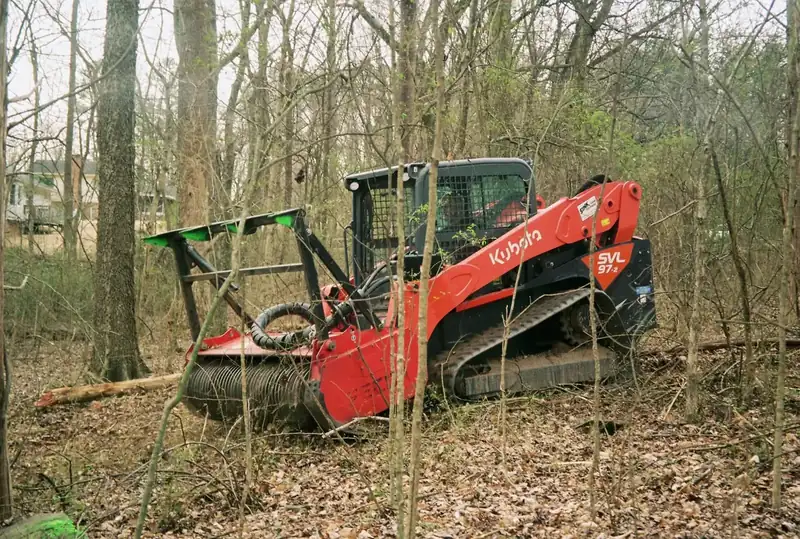
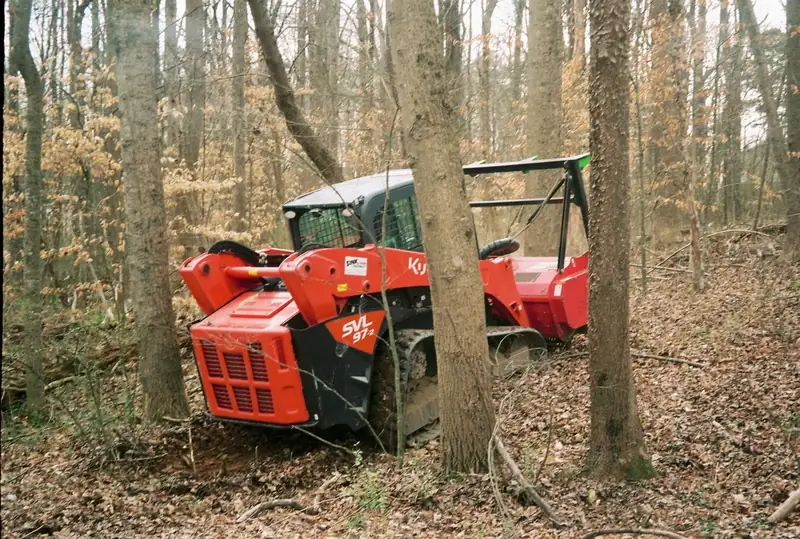
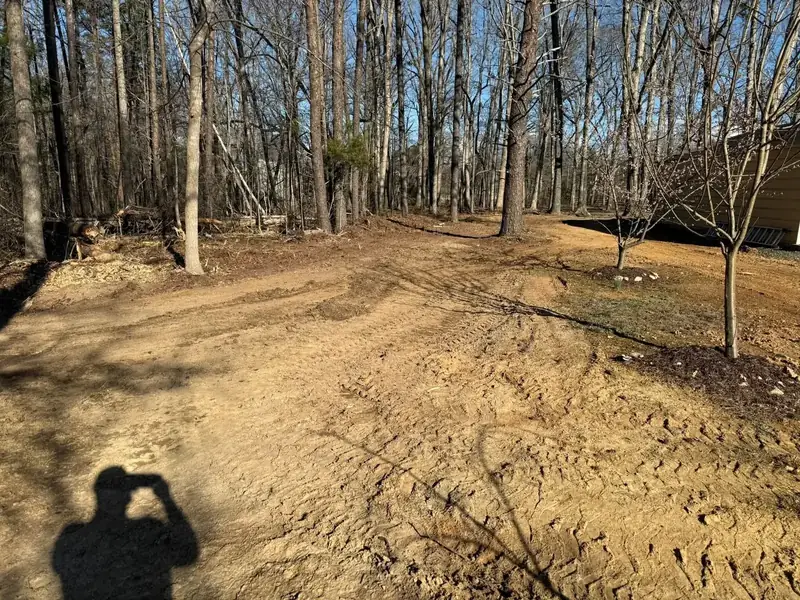
Martinsville ground conditions and how they shape bush hogging
Our Henry County work is rural and often on a grade. Old tobacco farms along US-220, US-58, NC-57 toward the state line and the back roads around Ridgeway and Axton are being reclaimed for cattle and hay or set up as homesteads — pasture mulched, fence rows opened, farm roads cut on contour, pole barn pads graded. Hunting tracts in the hills toward Philpott Lake and the Franklin County line need trails, firebreaks and food plots. The Smith River corridor and Philpott bring recreation and cabin buyers who want a site cleared and a path to the water. The Commonwealth Crossing industrial site south of town has brought some commercial clearing.
Around the Smith River, Leatherwood Creek and US-220, the properties we're usually called to look like this:
- Old tobacco farms along US-220, US-58 and toward Ridgeway and Axton reclaimed for cattle, hay or a homestead
- Smith River and Philpott cabin sites wanting clearing on a grade and a path to the water
- Working cattle farms with fence rows lost to rose and autumn olive and farm roads that wash every spring
What bush hogging jobs look like around Martinsville
Most of our bush hogging work in Martinsville comes from two directions. First, old tobacco farms along US-220, US-58 and toward Ridgeway and Axton reclaimed for cattle, hay or a homestead. Second, pasture edges, fence rows and corners a tractor can't reach.
Both show up regularly along US-220 and Martinsville Speedway, and both are jobs we can usually walk, quote and schedule inside a couple of weeks.
Danville, Madison and Danbury are in the same loop as Martinsville for us — same crew, same pricing basis.
Why Martinsville property owners call A&R
The track machine mows ground in Martinsville that a tractor-mounted hog can't — steep banks, soft bottoms, tight corners around buildings. You get the whole field cut, not just the part the tractor could reach.
Field mowing in Henry County is easiest on a schedule. Get in touch and we'll set up spring and late-summer cuts.
Bush Hogging in Martinsville: questions
What's the difference between bush hogging and forestry mulching?
The cutter handles grass, weeds, briars and saplings up to two or three inches, and leaves the material chopped on the ground. The mulcher grinds brush and trees up to eight or ten inches into chips. If your field has been let go long enough that the saplings are thicker than your thumb, it's a mulching job, and we'll tell you that rather than tear up the cutter.
How often should a field be bush hogged?
Twice a year keeps most Piedmont fields open — once in late spring after the first flush and once in late summer before the sweetgum and pine saplings harden off. Once a year works on fields that are mostly grass. Hay fields and wildlife ground have their own timing, and we'll work around nesting season if it applies.
How far is A&R Land Services from Martinsville?
We're based in Greensboro, about 1 hour 5 minutes from Martinsville. Henry County is inside the radius we work every week, so there's no long-haul mobilization charge built into your estimate.
Do you handle bush hogging near the Smith River and Leatherwood Creek?
Yes. We work throughout Martinsville and the surrounding Henry County area, including properties around the Smith River, Leatherwood Creek and US-220. If you're outside the town limits, send the address and we'll confirm it's in range.
How do you approach bush hogging on Martinsville ground?
Fields between tenants or between crops is the most common version of it around Martinsville. We look at the growth height and type, check for hidden fence, rock, wire and junk, and find the wet spots. If the growth is past what a cutter should handle, we'll tell you it's a mulching job. Slope and how rough the ground is is the factor that moves the price most on Henry County jobs, and we'll walk through it with you on site.