
Fire season in Burlington is spring and fall, when the leaves are down and the wind's up. The time to build the break is late winter, and a firefighter on the machine knows why. Call before the dry spell, not during it.
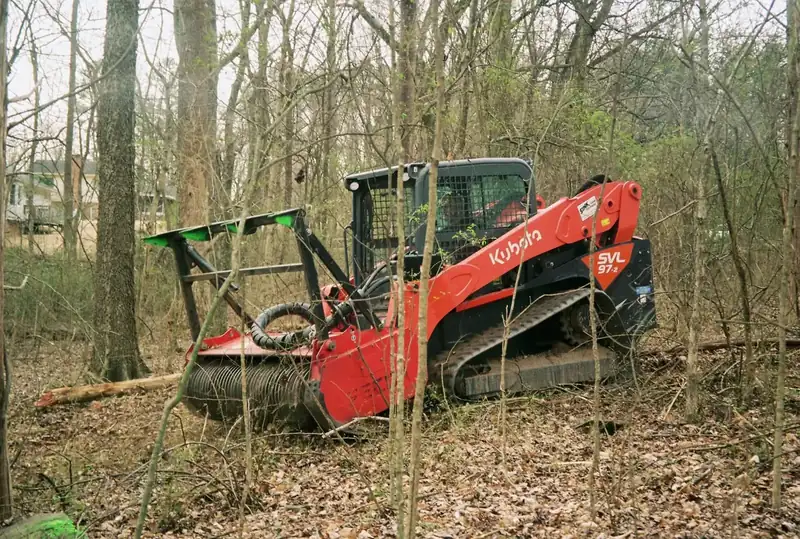
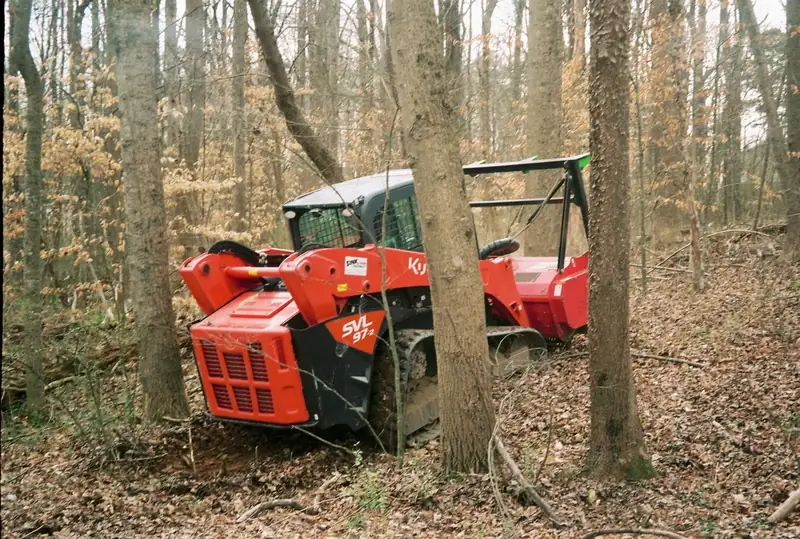
The fuel around Burlington homes is loblolly pine straw over a privet and honeysuckle understory, usually with a few dead pines standing in it. That mix burns fast and climbs. On Alamance County defensible space jobs we take the understory, limb the pines, and drop the dead ones first.
Burlington ground conditions and how they shape firebreaks
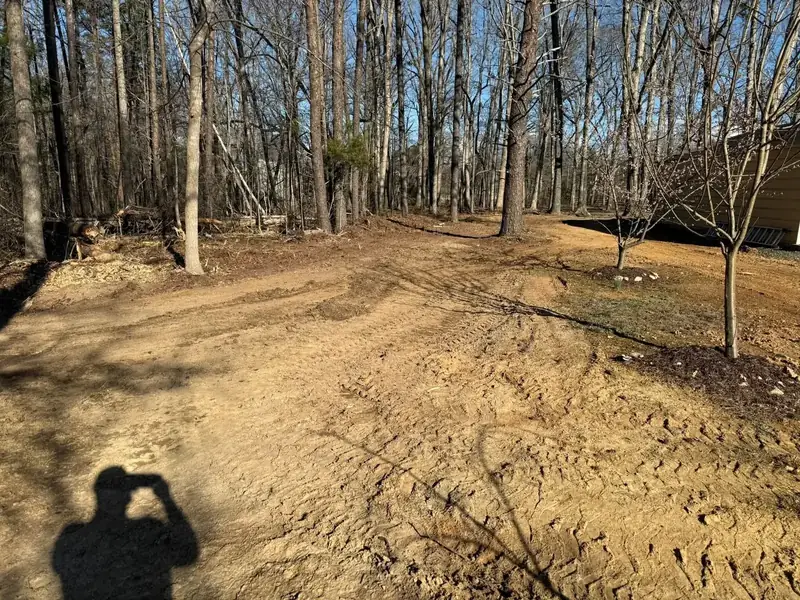
Iredell clay rules the schedule. It's slick as grease when wet, cracks open in August, and will not grade cleanly until it's had a dry week. We watch the forecast and run track machines on it. Drainage work — swales, French drains, ditch cleaning — is a bigger share of the job in Burlington than anywhere else we work. Both city lakes are water supply, so the watershed overlays require buffers and limit impervious cover, and Alamance County erosion control covers disturbance past an acre outside city limits.
Around the Glen Raven and Elon area, Garden Road and Big Alamance Creek, the properties we're usually called to look like this:
- Former textile and hosiery mill parcels along the rail line and the Haw River overgrown with privet, kudzu and Bradford pear
- Five- to twenty-acre rural lots north toward Lake Cammack and south toward Lake Mackintosh opening house sites and pasture
- Flat Iredell clay yards and fields that hold water and need swales, French drains and ditching
What firebreaks jobs look like around Burlington
One job we see over and over near Big Alamance Creek: Former textile and hosiery mill parcels along the rail line and the Haw River overgrown with privet, kudzu and Bradford pear. That's textbook firebreaks work, and it's usually a one-mobilization job for us.
Out toward Church Street (NC-62) the pattern changes — more Subdivisions and HOAs on the edge of large wooded tracts. The approach is the same, the time on site is what moves.
Either way, the first question we ask on a Burlington site walk is what the ground needs to do afterward, because that decides how far we take it.
Elon, Greensboro and Mebane are in the same loop as Burlington for us — same crew, same pricing basis.
Why Burlington property owners call A&R
We tell Alamance County landowners what actually helps and skip the rest. A thirty-foot mulched ring, limbed trees and the dead pines down does more for a Burlington house than any amount of thinning two hundred feet out.
For firebreaks and defensible space in Burlington, call (336) 392-8138 before fire season, not during it.
Firebreaks in Burlington: questions
Do I need a permit to clear defensible space?
Mulching brush around your own house doesn't need a permit. If the firebreak disturbs more than an acre to bare soil, NC erosion rules can apply, and if it runs through a creek buffer we'll keep it mulched rather than bladed there. Burning debris afterward requires a burn permit from the NC Forest Service, which is free and online.
What areas do you serve for firebreaks?
Greensboro and about an hour and twenty minutes in every direction — the Triad, north to the Virginia line through Rockingham and Stokes, west to Mount Airy and Elkin, south to Salisbury, Albemarle and Sanford, and east to Durham, Chapel Hill and Raleigh.
How far is A&R Land Services from Burlington?
We're based in Greensboro, about 25 minutes from Burlington. Alamance County is inside the radius we work every week, so there's no long-haul mobilization charge built into your estimate.
Do you handle firebreaks near the Glen Raven and Elon area and Garden Road?
Yes. We work throughout Burlington and the surrounding Alamance County area, including properties around the Glen Raven and Elon area, Garden Road and Big Alamance Creek. If you're outside the town limits, send the address and we'll confirm it's in range.
What does firebreaks typically involve on a Burlington property?
Barns, shops and equipment sheds surrounded by brush is the most common version of it around Burlington. We walk the zones and the break together, point out what to keep up with each season — the leaf layer, the firewood, the regrowth — and set a follow-up if you want the break maintained. Slope and terrain along the line is the factor that moves the price most on Alamance County jobs, and we'll walk through it with you on site.