
Rural homes in Gibsonville sit in the kind of pine and privet that carries a brush fire straight to the siding. A&R Land Services mulches defensible space and cuts firebreaks across Guilford / Alamance County, run by a working firefighter who's seen what thirty feet of clean ground does. We're about 20 minutes away in Greensboro.
Guilford / Alamance County gets brush fires every dry stretch, mostly from debris burns that get away. A mulched or bladed break on your Gibsonville line is what keeps a neighbor's escaped burn from becoming your problem.
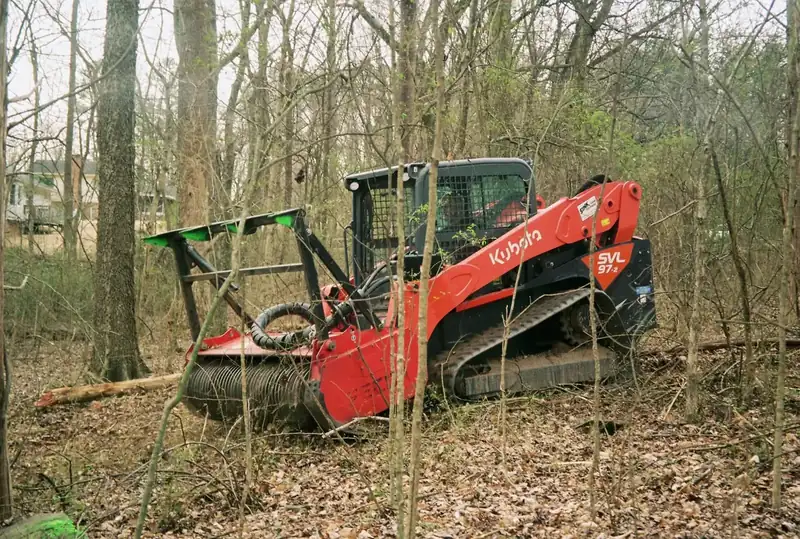
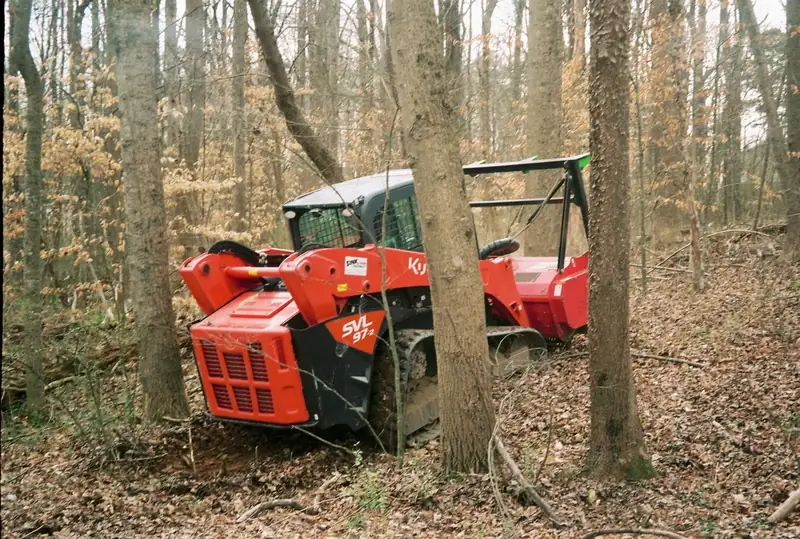
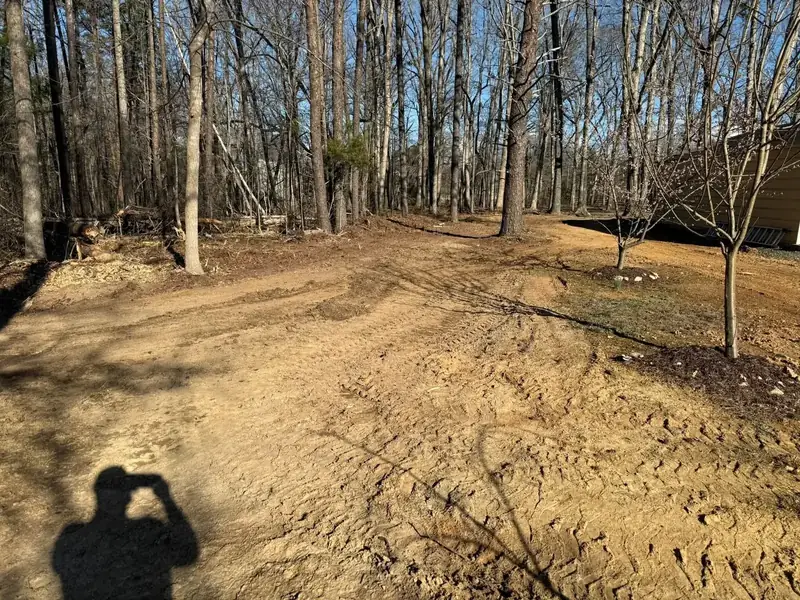
Gibsonville ground conditions and how they shape firebreaks
Gibsonville is where the soil changes under your feet. West of town it's still Cecil red clay, but moving east toward Elon and Burlington you cross onto a belt of Enon, Iredell and Mecklenburg soils formed over diabase and gabbro. Iredell is the one to respect — a sticky gray clay that swells wet, shrinks dry and drains about as well as a parking lot. Old-timers call it blackjack land. Travis Creek and several small branches feed toward the Haw River north of town, and those low fields are the last to dry in spring. Growth on fallow land here is loblolly, red cedar, sweetgum and a privet understory.
Around Haw River, Burlington Road (US-70) and Springwood Avenue, the properties we're usually called to look like this:
- Fence-line and hedgerow clearing on the Alamance side where honeysuckle has buried the wire
- Small hay and cattle farms off NC-61 and Burlington Road being split for family home sites
- One- to two-acre build lots on the Guilford side where subdivisions are pushing out from McLeansville and Whitsett
What firebreaks jobs look like around Gibsonville
Around Springwood Avenue, the properties that call us for firebreaks tend to be fence-line and hedgerow clearing on the Alamance side where honeysuckle has buried the wire.
Closer to Burlington Avenue it's more often landowners who run controlled burns and need control lines — different layout, same machine, and the estimate reflects the difference honestly.
Gibsonville isn't one kind of ground, and we don't price it like it is.
If you're just outside Gibsonville — Greensboro, Mcleansville, Burlington or anywhere between — you're still inside our regular range.
Why Gibsonville property owners call A&R
Greensboro to Gibsonville is about 20 minutes, which makes a maintenance pass on the break every year or two practical. Breaks grow back in; we're close enough to keep yours open.
Send us photos of what's growing against your Gibsonville house or barn and we'll tell you what it'll take to make it defensible.
Firebreaks in Gibsonville: questions
How wide should a firebreak be?
Ten feet is a minimum for a mulched or bladed line on flat ground with light fuel. Twenty to thirty feet is better alongside a pine stand, a cutover or a slope. Around a house, thirty feet of cleaned ground is the standard defensible zone, with lighter thinning out to a hundred. Wider is better; the break has to be wide enough that embers and radiant heat don't cross it.
What areas do you serve for firebreaks?
Greensboro and about an hour and twenty minutes in every direction — the Triad, north to the Virginia line through Rockingham and Stokes, west to Mount Airy and Elkin, south to Salisbury, Albemarle and Sanford, and east to Durham, Chapel Hill and Raleigh.
How far is A&R Land Services from Gibsonville?
We're based in Greensboro, about 20 minutes from Gibsonville. Guilford / Alamance County is inside the radius we work every week, so there's no long-haul mobilization charge built into your estimate.
Do you handle firebreaks near Haw River and Burlington Road (US-70)?
Yes. We work throughout Gibsonville and the surrounding Guilford / Alamance County area, including properties around Haw River, Burlington Road (US-70) and Springwood Avenue. If you're outside the town limits, send the address and we'll confirm it's in range.
What should I expect from a firebreaks job in Guilford / Alamance County?
Pine stands and timber investments worth protecting is the most common version of it around Gibsonville. A written estimate that lays out the mulched ring, the limbing height, the thinning beyond it, and any bladed line — with the price. If a dead tree is a hazard to the house, it's called out. Fuel density — solid privet and dead pine versus open woods is the factor that moves the price most on Guilford / Alamance County jobs, and we'll walk through it with you on site.