
Privet and kudzu don't respect property lines in Durham, and once they're established they take the lot. A&R Land Services mulches invasive thickets off Durham County properties and leaves you with a plan to keep them down — straight talk about what will come back and when. We're about 55 minutes away in Greensboro.
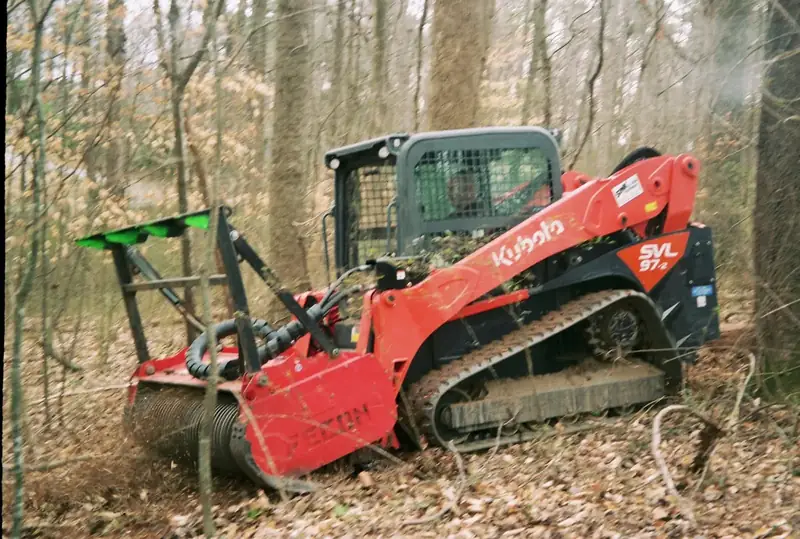
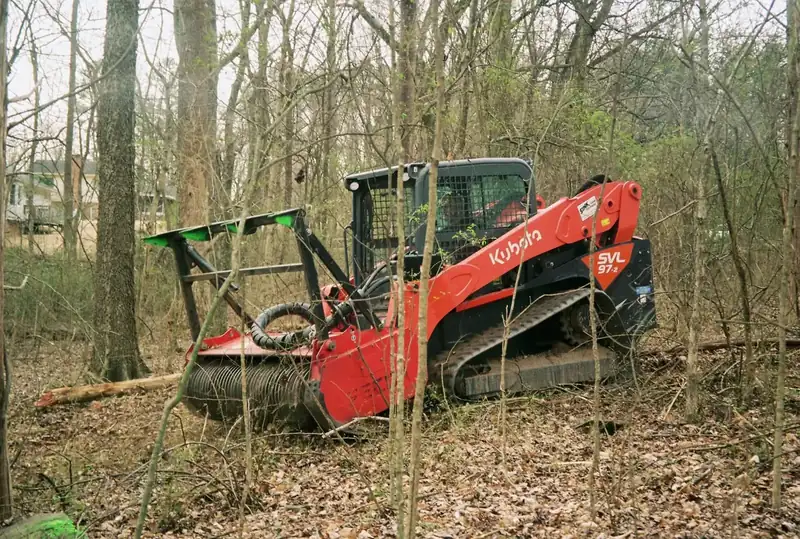
Kudzu around Durham tends to be on road banks, old home sites and south-facing slopes where it was planted for erosion control decades ago. We strip the mass with the mulcher, leave the chips on the slope so the clay doesn't wash, and flag the crowns for follow-up.
Durham ground conditions and how they shape invasive removal
Durham is the county where the Triassic basin bites hardest. From downtown south and east through Research Triangle Park, Parkwood and toward Falls of Neuse, the soils are White Store, Creedmoor and Mayodan — dense, slick, shrink-swell clays over red shale and sandstone. Wet, they will grab a track machine and hold it; dry, they crack and set like brick. North Durham past Bahama and Rougemont climbs out of the basin onto Georgeville and Tatum slate soils that behave completely differently. Knowing which side of that line a parcel sits on is the first thing we figure out.
Around the Little River, NC-751 and Falls Lake, the properties we're usually called to look like this:
- Commercial outparcels around RTP, NC-55 and US-70 east needing rough grading and debris removal
- Church and school properties with wooded back acreage they want opened for parking, fields or trails
- Falls Lake-adjacent tracts off Redwood Road and Old Oxford Road with buffer-limited clearing and trail work
What invasive removal jobs look like around Durham
One job we see over and over near Falls Lake: Commercial outparcels around RTP, NC-55 and US-70 east needing rough grading and debris removal. That's textbook invasive removal work, and it's usually a one-mobilization job for us.
Out toward the Flat River the pattern changes — more Vines pulling down keeper trees and fences. The approach is the same, the time on site is what moves.
Either way, the first question we ask on a Durham site walk is what the ground needs to do afterward, because that decides how far we take it.
Chapel Hill, Roxboro and Hillsborough are in the same loop as Durham for us — same crew, same pricing basis.
Why Durham property owners call A&R
Greensboro to Durham is about 55 minutes, which makes a follow-up visit the next spring practical. We're in Durham County regularly and can hit the resprouts while they're small, which is when the job actually gets won.
Send us photos of what's taken over your Durham lot. We'll tell you what it is and what it takes to get ahead of it.
Invasive Removal in Durham: questions
Can kudzu be removed permanently?
Yes, with persistence. Mulching strips the vine mass, and then the crowns have to be exhausted — either by mowing every few weeks through two or three growing seasons, or by a licensed applicator treating them. We do the mechanical part and leave the crowns easy to find. Kudzu that gets one pass and then gets ignored is back the next year.
Can you remove bamboo for good?
Running bamboo has to be dug. The rhizome mat is usually in the top foot or so of soil, and the mini excavator can lift it out across the infested area. It's more work than mulching, and if the stand is rooted across a property line the neighbor's side will keep sending runners unless there's a barrier or they're removing theirs too. We'll give you the straight version on the walk-through.
How far is A&R Land Services from Durham?
We're based in Greensboro, about 55 minutes from Durham. Durham County is inside the radius we work every week, so there's no long-haul mobilization charge built into your estimate.
Do you handle invasive removal near the Little River and NC-751?
Yes. We work throughout Durham and the surrounding Durham County area, including properties around the Little River, NC-751 and Falls Lake. If you're outside the town limits, send the address and we'll confirm it's in range.
What should I expect from a invasive removal job in Durham County?
Privet thickets choking wooded lots and creek bottoms is the most common version of it around Durham. We walk it with you, show you what will come back and when, and schedule a mowing or second-pass visit if you want us handling it. Resprouts are small the first year — that's when to hit them. Slope and creek buffer limits on where the machine can run is the factor that moves the price most on Durham County jobs, and we'll walk through it with you on site.