

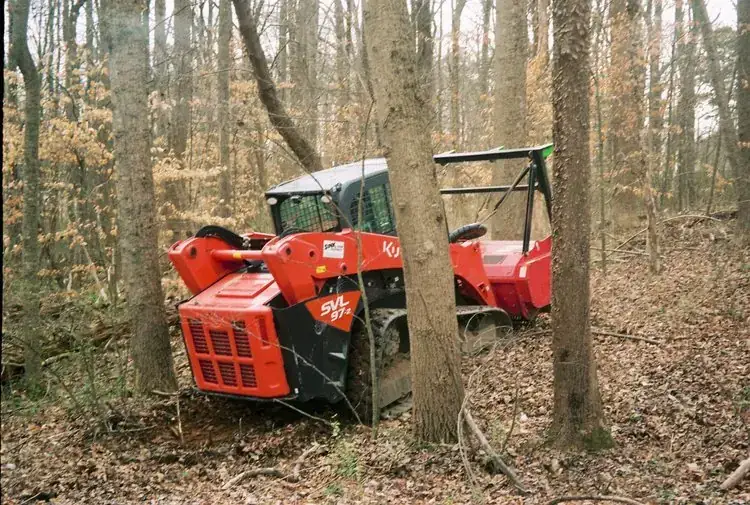
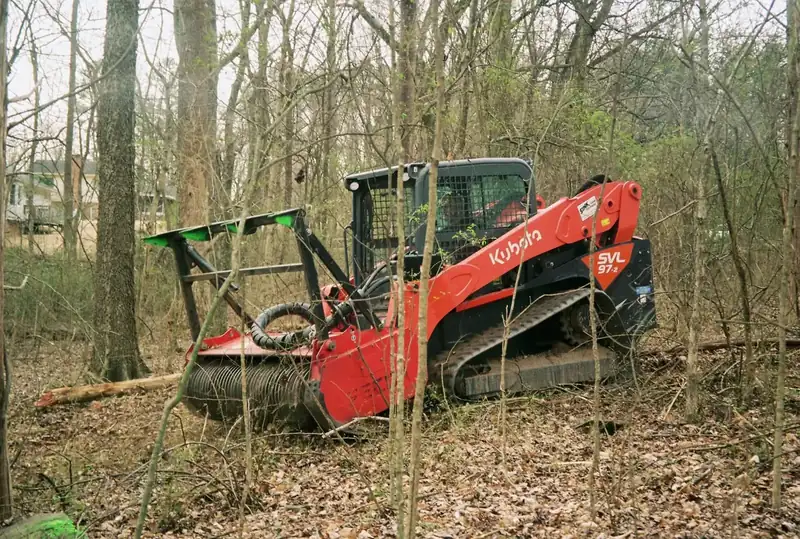
Pasture reclamation in Gibsonville is mostly a mulching job if you catch it before the pines get big. We take the sweetgum, loblolly, cedar and privet to grade in a pass, find the old fence before we hit it, and leave the ground ready to mow and seed.
Piedmont clay around Gibsonville runs acidic, and a field that's been in pine for a decade is worse. Reclaiming it means liming heavy after we mulch — we'll tell you that up front so the seeding plan is realistic.
Gibsonville ground conditions and how they shape pasture reclamation
On Iredell ground we'll tell you straight: don't grade it wet. It turns to grease, ruts three feet deep and sets like concrete when it dries. We wait for a solid dry week and we use a track machine. Drainage work is a bigger share of the job here than in most towns — French drains, swales and ditch cleaning to get water off the flat clay and moving toward the creek. Since the town spans two counties, we check which erosion control office has jurisdiction before we start anything over an acre.
Around Burlington Road (US-70), Lake Mackintosh (south) and Minneola Mill, the properties we're usually called to look like this:
- One- to two-acre build lots on the Guilford side where subdivisions are pushing out from McLeansville and Whitsett
- Fence-line and hedgerow clearing on the Alamance side where honeysuckle has buried the wire
- Small hay and cattle farms off NC-61 and Burlington Road being split for family home sites
What pasture reclamation jobs look like around Gibsonville
One job we see over and over near Minneola Mill: One- to two-acre build lots on the Guilford side where subdivisions are pushing out from McLeansville and Whitsett. That's textbook pasture reclamation work, and it's usually a one-mobilization job for us.
Out toward Springwood Avenue the pattern changes — more Cattle and horse pasture being brought back into production. The approach is the same, the time on site is what moves.
Either way, the first question we ask on a Gibsonville site walk is what the ground needs to do afterward, because that decides how far we take it.
If you're just outside Gibsonville — Whitsett, Burlington, Mcleansville or anywhere between — you're still inside our regular range.
Why Gibsonville property owners call A&R
If the field needs the pond edge cleaned, a drainage ditch opened, or a fence corridor set while we're there, we handle it in the same trip. One contractor for the whole Guilford / Alamance County reclamation.
Call or text (336) 392-8138 to set up a free pasture reclamation estimate in Gibsonville. We'll walk the field together and tell you what it'll take to get it back to grass.
Pasture Reclamation in Gibsonville: questions
Can you find and remove the old fence?
Yes, and we do it before the mulcher gets near it. Old woven wire and barbed wire in a mulching head is expensive, so we walk the field, locate the lines, pull the wire with the grapple and pile it. Posts worth saving get flagged.
How much does it cost to reclaim an overgrown pasture?
Fields that have been let go five to ten years with pines under eight inches are the most economical — the mulcher runs fast and nothing needs hauling. Older fields with bigger timber take longer and may be worth logging first. Pulling stumps and removing chips for bare ground roughly doubles the work compared with mulching in place. We walk the field and give a written price, and the estimate is free.
How far is A&R Land Services from Gibsonville?
We're based in Greensboro, about 20 minutes from Gibsonville. Guilford / Alamance County is inside the radius we work every week, so there's no long-haul mobilization charge built into your estimate.
Do you handle pasture reclamation near Burlington Road (US-70) and Lake Mackintosh (south)?
Yes. We work throughout Gibsonville and the surrounding Guilford / Alamance County area, including properties around Burlington Road (US-70), Lake Mackintosh (south) and Minneola Mill. If you're outside the town limits, send the address and we'll confirm it's in range.
What does pasture reclamation typically involve on a Gibsonville property?
Expanding existing pasture into the grown-up edges is the most common version of it around Gibsonville. We walk the field with you and talk through the mowing, liming and seeding schedule that'll actually get it back into production, and whether any drainage or fence work should happen while the ground is open. Acreage and how long the field has been out of production is the factor that moves the price most on Guilford / Alamance County jobs, and we'll walk through it with you on site.