
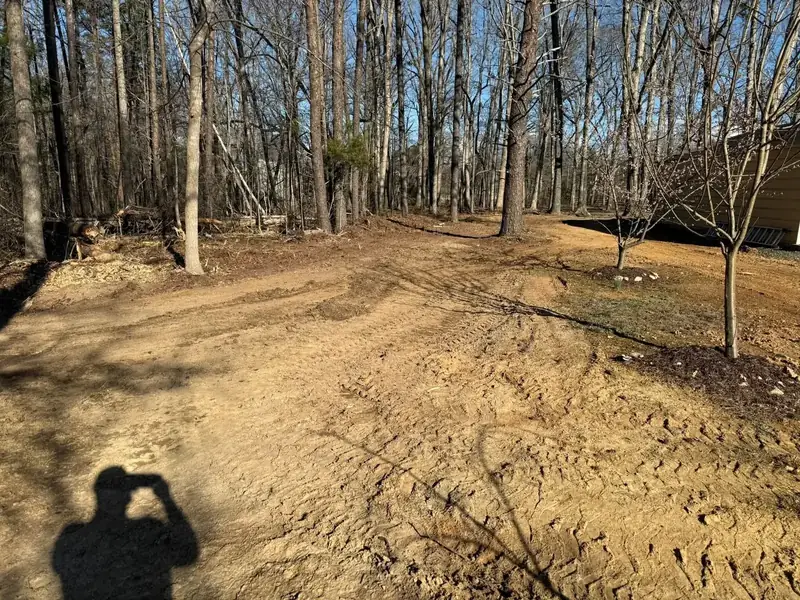
If your builder in Chapel Hill has finished and left you a yard of red clay and tire tracks, that's where we come in. We're about 55 minutes away in Greensboro, and a seed-ready final grade is usually a one or two day job with a box blade, a laser and a few loads of topsoil.
Properties in Chapel Hill with septic systems need a lighter touch on the final grade. We shape over the drain field without cutting into it and keep the loader off the trenches. Water needs to shed off the field, not pool on it, and that's a grading detail a lot of crews miss.
Chapel Hill ground conditions and how they shape final grading
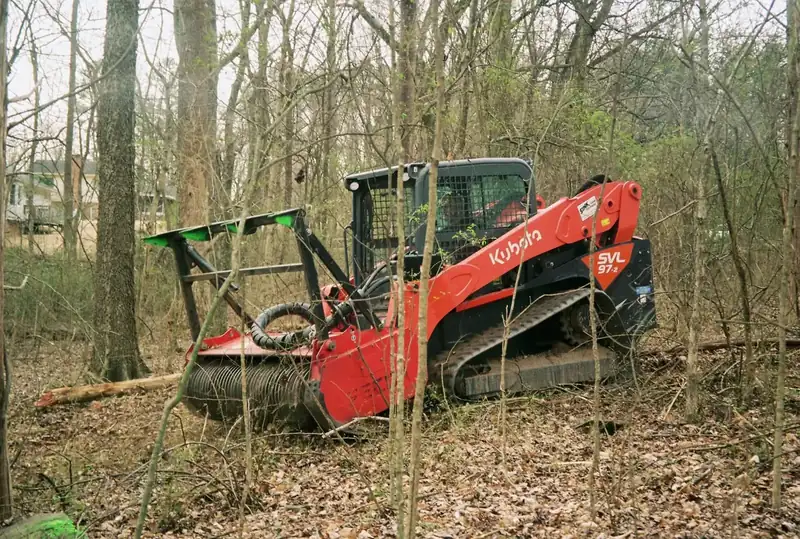
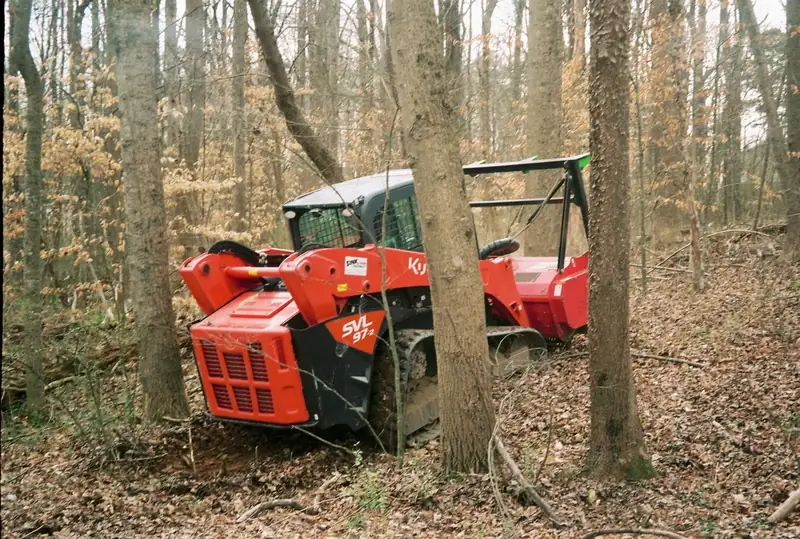
Out past Carrboro toward White Cross, Dairyland Road and the Jordan Lake side of town, the parcels open up to five, ten and twenty acres with real woods: oak and hickory on the high ground, loblolly and sweetgum where it was farmed, and privet, wisteria and English ivy anywhere a homeowner stopped paying attention. Morgan Creek, Bolin Creek and New Hope Creek all run through here on their way to Jordan Lake, and the bottoms along them are where the biggest brush problems live.
Around Jordan Lake, US-15/501 and Mount Carmel Church Road, the properties we're usually called to look like this:
- Five- to twenty-acre wooded tracts west of Carrboro along Dairyland Road and Old Greensboro Road being opened up for a home and small pasture
- University-area rental properties with overgrown creek frontage on Bolin or Morgan Creek
- Infill lots in Northside and along Rogers Road that have grown up for twenty years and need clearing to the buffer line
What final grading jobs look like around Chapel Hill
Around Mount Carmel Church Road, the properties that call us for final grading tend to be five- to twenty-acre wooded tracts west of Carrboro along Dairyland Road and Old Greensboro Road being opened up for a home and small pasture.
Closer to the Rogers Road and Northside neighborhoods it's more often bare clay that won't grow grass no matter what's thrown at it — different layout, same machine, and the estimate reflects the difference honestly.
Chapel Hill isn't one kind of ground, and we don't price it like it is.
Cary, Durham and Hillsborough are in the same loop as Chapel Hill for us — same crew, same pricing basis.
Why Chapel Hill property owners call A&R
A finished surface from A&R is actually finished. Chapel Hill seed and sod crews can start the same day without another pass — that's the standard we work to.
A&R Land Services finish-grades lots across Orange County from Greensboro. Call (336) 392-8138 and we'll set up a site visit in Chapel Hill.
Final Grading in Chapel Hill: questions
Do you serve the whole Triad for final grading?
We're in Greensboro and cover roughly an hour and twenty minutes out — Winston-Salem, High Point, Burlington, Asheboro, Reidsville, Mount Airy, Elkin, Salisbury, Albemarle, Sanford, Durham, Chapel Hill and Raleigh, and everything in between.
Will grass grow on the red clay if you just smooth it?
Poorly. Bermuda will take on bare clay if you fight it long enough, but fescue — the lawn most people in the Triad want — needs real topsoil to root in. Smoothing clay without topsoil gives you a surface that crusts, sheds water and bakes in July. We recommend topsoil on every final grade for a lawn.
How far is A&R Land Services from Chapel Hill?
We're based in Greensboro, about 55 minutes from Chapel Hill. Orange County is inside the radius we work every week, so there's no long-haul mobilization charge built into your estimate.
Do you handle final grading near Jordan Lake and US-15/501?
Yes. We work throughout Chapel Hill and the surrounding Orange County area, including properties around Jordan Lake, US-15/501 and Mount Carmel Church Road. If you're outside the town limits, send the address and we'll confirm it's in range.
How do you approach final grading on Chapel Hill ground?
New homes after the trades are out and before landscaping is the most common version of it around Chapel Hill. We shoot the existing grade around the foundation and across the lot, mark the problem areas, and set stakes for the slope we're going to build. Soil moisture and time of year is the factor that moves the price most on Orange County jobs, and we'll walk through it with you on site.