
Fire season in Chapel Hill is spring and fall, when the leaves are down and the wind's up. The time to build the break is late winter, and a firefighter on the machine knows why. Call before the dry spell, not during it.
The fuel around Chapel Hill homes is loblolly pine straw over a privet and honeysuckle understory, usually with a few dead pines standing in it. That mix burns fast and climbs. On Orange County defensible space jobs we take the understory, limb the pines, and drop the dead ones first.
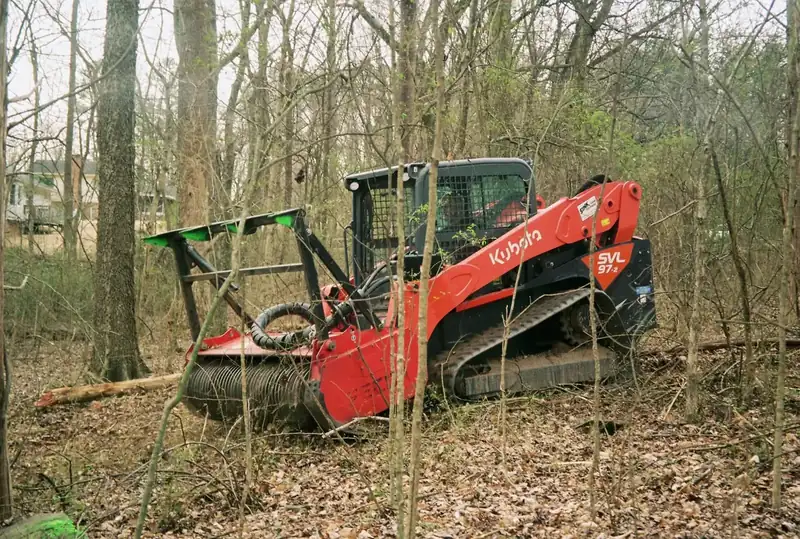
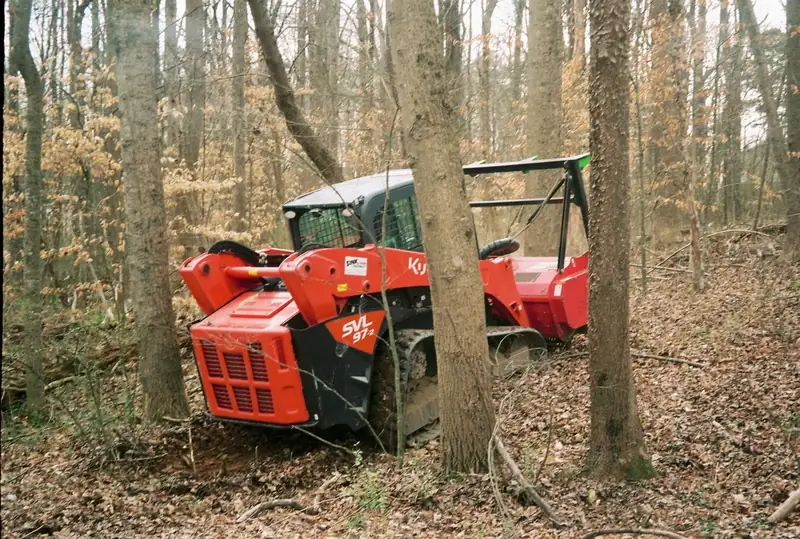
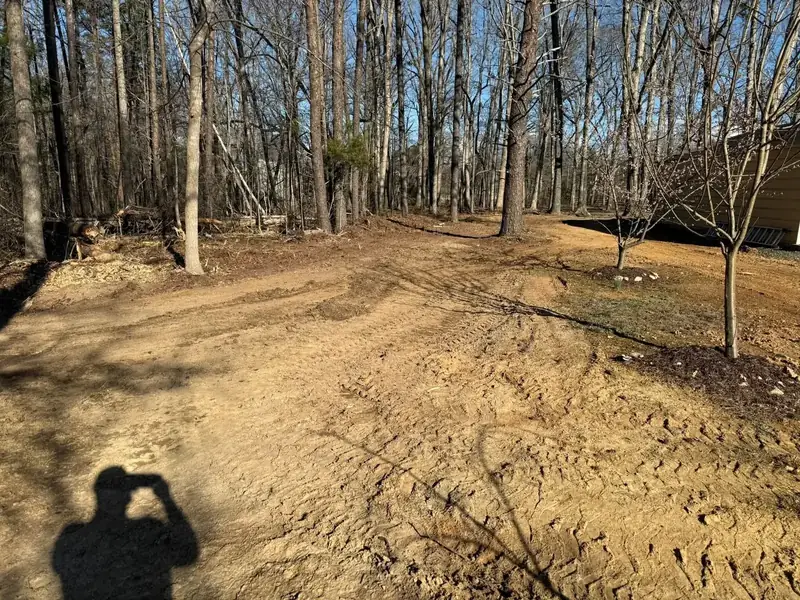
Chapel Hill ground conditions and how they shape firebreaks
Out past Carrboro toward White Cross, Dairyland Road and the Jordan Lake side of town, the parcels open up to five, ten and twenty acres with real woods: oak and hickory on the high ground, loblolly and sweetgum where it was farmed, and privet, wisteria and English ivy anywhere a homeowner stopped paying attention. Morgan Creek, Bolin Creek and New Hope Creek all run through here on their way to Jordan Lake, and the bottoms along them are where the biggest brush problems live.
Around New Hope Creek, White Cross and Morgan Creek, the properties we're usually called to look like this:
- Steep, privet-choked backyards and side lots in older neighborhoods off Mount Carmel Church Road and Smith Level Road
- Estate lots in Governors Club and the US-15/501 corridor that need understory mulching for views and fire safety
- Infill lots in Northside and along Rogers Road that have grown up for twenty years and need clearing to the buffer line
What firebreaks jobs look like around Chapel Hill
If you're near Morgan Creek or Old Greensboro Road, odds are your situation is one we've already worked: steep, privet-choked backyards and side lots in older neighborhoods off Mount Carmel Church Road and Smith Level Road, or property lines bordering cutovers, pine plantations or neighbors who burn.
The firebreaks approach for Orange County ground is the same either way — look first, quote in writing, bring the right attachment, walk it with you when it's done.
We also cover firebreaks in Durham, Efland and Saxapahaw, so if you've got property in more than one spot we can often batch the work.
Why Chapel Hill property owners call A&R
We tell Orange County landowners what actually helps and skip the rest. A thirty-foot mulched ring, limbed trees and the dead pines down does more for a Chapel Hill house than any amount of thinning two hundred feet out.
For firebreaks and defensible space in Chapel Hill, call (336) 392-8138 before fire season, not during it.
Firebreaks in Chapel Hill: questions
Is a mulched firebreak effective, or does it need to be bare dirt?
A mulched strip stops a ground fire in most Piedmont conditions because the chips don't carry flame the way standing brush and pine straw do. For a control line you'll burn against, or on a slope with heavy fuel, bare mineral soil is the standard and we blade it. We'll tell you which your situation calls for.
How wide should a firebreak be?
Ten feet is a minimum for a mulched or bladed line on flat ground with light fuel. Twenty to thirty feet is better alongside a pine stand, a cutover or a slope. Around a house, thirty feet of cleaned ground is the standard defensible zone, with lighter thinning out to a hundred. Wider is better; the break has to be wide enough that embers and radiant heat don't cross it.
How far is A&R Land Services from Chapel Hill?
We're based in Greensboro, about 55 minutes from Chapel Hill. Orange County is inside the radius we work every week, so there's no long-haul mobilization charge built into your estimate.
Do you handle firebreaks near New Hope Creek and White Cross?
Yes. We work throughout Chapel Hill and the surrounding Orange County area, including properties around New Hope Creek, White Cross and Morgan Creek. If you're outside the town limits, send the address and we'll confirm it's in range.
How do you approach firebreaks on Chapel Hill ground?
Hunting camps and remote structures with no hydrant nearby is the most common version of it around Chapel Hill. Along a line or around a stand, the mulcher runs the strip to the planned width. If the break goes to bare soil, the blade follows and the strip is left clean enough to drive. Length and width of the firebreak is the factor that moves the price most on Orange County jobs, and we'll walk through it with you on site.