
Defensible space in Apex means brush mulched back from the walls, trees limbed up, dead pines dropped, and the ground floored with chips instead of pine straw. We do the heavy part in a day and show you what to keep up with each season.
Landowners around Apex who run controlled burns on their own ground need control lines they can trust. We blade those to mineral soil on Wake County tracts, wide enough to burn against and clean enough to drive a truck down.
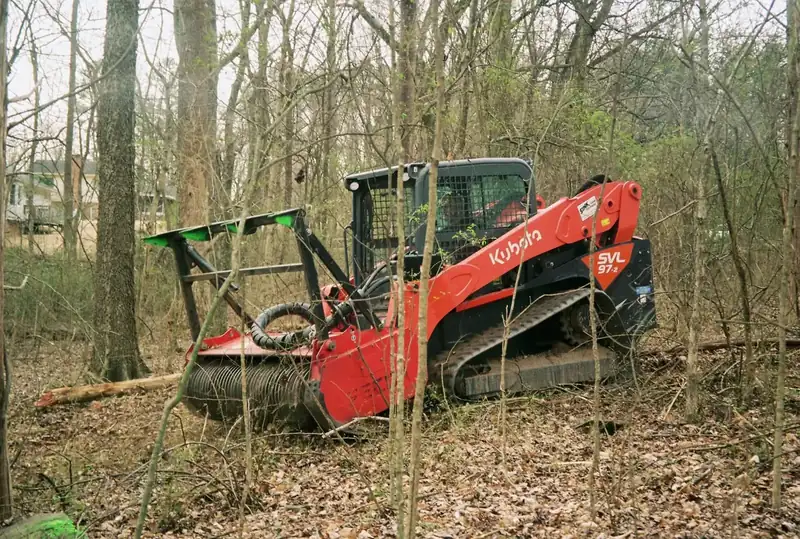
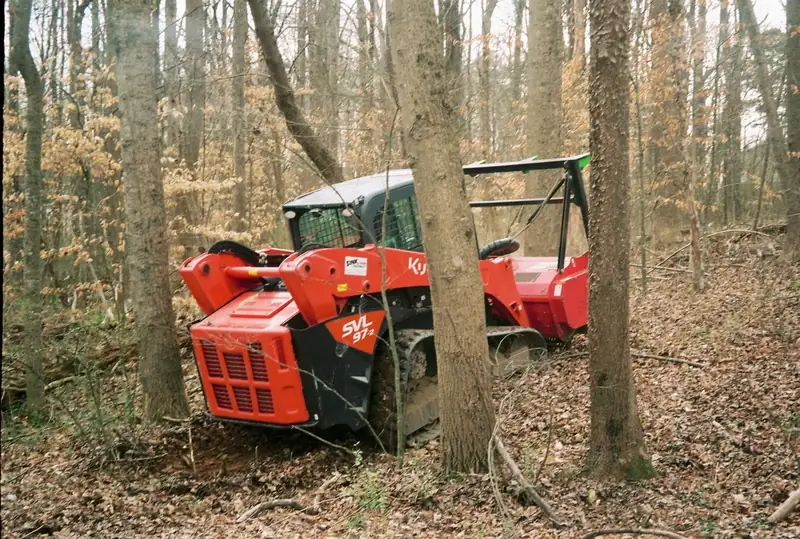
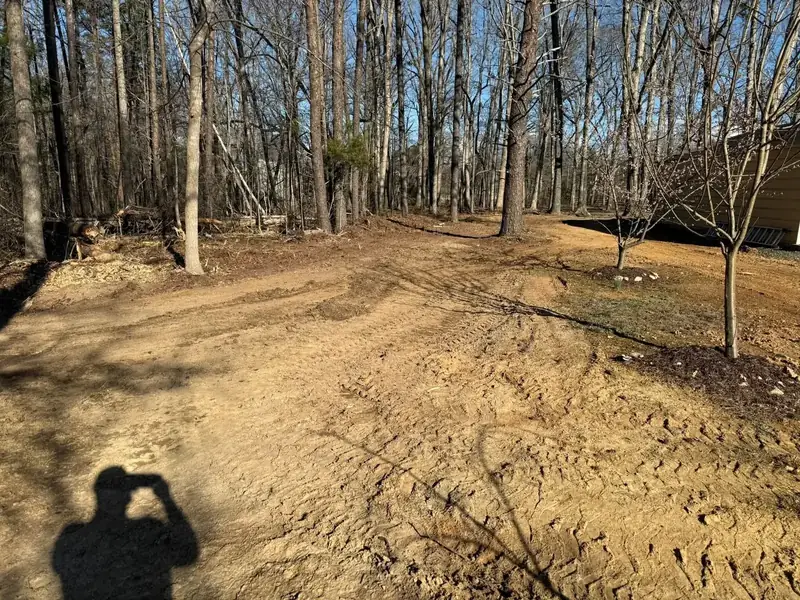
Apex ground conditions and how they shape firebreaks
Apex is southwestern Wake County, and most of it sits on the Durham Triassic basin — White Store, Creedmoor and Mayodan clays over red shale that are greasy after a rain and set hard in a drought. The eastern edge toward Holly Springs and Cary shifts to Cecil and Appling. Beaver Creek, Middle Creek and White Oak Creek drain the town, Beaver Creek toward Jordan Lake and the others toward the Neuse. Old tobacco and dairy land here went to loblolly and sweetgum, and the creek bottoms are box elder and privet with wisteria climbing anything that holds still.
Around Friendship, White Oak Creek and Jordan Lake, the properties we're usually called to look like this:
- Former farms along US-64, NC-55 and Jenks Road being cleared and rough graded for subdivisions
- Commercial outparcels along US-1 and NC-55 needing clearing and rough grading
- Older estate lots off Olive Chapel Road and Salem Church Road wanting understory mulched and vines removed
What firebreaks jobs look like around Apex
One job we see over and over near Jordan Lake: Former farms along US-64, NC-55 and Jenks Road being cleared and rough graded for subdivisions. That's textbook firebreaks work, and it's usually a one-mobilization job for us.
Out toward US-1 the pattern changes — more Landowners who run controlled burns and need control lines. The approach is the same, the time on site is what moves.
Either way, the first question we ask on a Apex site walk is what the ground needs to do afterward, because that decides how far we take it.
If you're just outside Apex — Raleigh, Cary, Sanford or anywhere between — you're still inside our regular range.
Why Apex property owners call A&R
If the break needs a culvert where it crosses a branch, a gate at the road, or a gravel surface so it works as the farm lane, we do it in the same Wake County trip.
Call or text (336) 392-8138 to have a firefighter walk your Apex property and show you where the fuel is. The estimate is free.
Firebreaks in Apex: questions
How wide should a firebreak be?
Ten feet is a minimum for a mulched or bladed line on flat ground with light fuel. Twenty to thirty feet is better alongside a pine stand, a cutover or a slope. Around a house, thirty feet of cleaned ground is the standard defensible zone, with lighter thinning out to a hundred. Wider is better; the break has to be wide enough that embers and radiant heat don't cross it.
How much does it cost to create defensible space around a house?
A thirty-foot mulched ring with limbing around a typical rural home is usually a day's work, and a longer firebreak along a property line is priced by its length and width. Fuel density, dead trees near the house, and whether the break goes to bare soil are the main variables. We walk it from the house out and give a written number. Estimates are free, and we'll tell you what actually matters on your ground.
How far is A&R Land Services from Apex?
We're based in Greensboro, about 1 hour 10 minutes from Apex. Wake County is inside the radius we work every week, so there's no long-haul mobilization charge built into your estimate.
Do you handle firebreaks near Friendship and White Oak Creek?
Yes. We work throughout Apex and the surrounding Wake County area, including properties around Friendship, White Oak Creek and Jordan Lake. If you're outside the town limits, send the address and we'll confirm it's in range.
What should I expect from a firebreaks job in Wake County?
Pine stands and timber investments worth protecting is the most common version of it around Apex. We walk the zones and the break together, point out what to keep up with each season — the leaf layer, the firewood, the regrowth — and set a follow-up if you want the break maintained. Fuel density — solid privet and dead pine versus open woods is the factor that moves the price most on Wake County jobs, and we'll walk through it with you on site.